Google AI Studio might be the best AI coding platform.
🎯 What is Google AI Studio?
Google AI Studio is a free AI coding platform that lets you build AI-powered apps using Google's Gemini 3 model. Unlike other AI coders, there's no API setup required—everything is built-in. Perfect for prototyping chatbots, language tutors, and AI assistants.
Best for: Free AI prototyping • Gemini 3 integration • Voice-enabled apps • Quick experiments
Quick Verdict: Is Google AI Studio Worth It?
✅ Yes, if: You want free AI prototyping, love Google's ecosystem, or need voice-enabled apps
❌ No, if: You need full-stack deployment, want to use GPT-5/Claude, or require complex databases
In this review, you're going to watch me build an AI language learning platform that, once I built it, blew me away.
We'll cover everything from getting started with the platform to debugging tips that will help you create a functional and engaging app
Google AI Studio Pricing (2026)
One of the biggest advantages of Google AI Studio is the pricing: it's completely free for prototyping.
| What You Get | Cost |
|---|---|
| AI Studio platform access | Free |
| Gemini 3 API (prototyping) | Free |
| Export code to local development | Free |
| Deployment to Google Cloud | Pay-as-you-go (varies) |
| Production Gemini API usage | Pay-as-you-go |
Bottom line: You can build and test AI apps completely free. You only pay when you deploy to production and have real users.
Getting Started with Google AI Studio Chatterbots
To begin building your conversational language learning app, follow these simple steps:
- Go to AI Studio and navigate to the "Build" section.
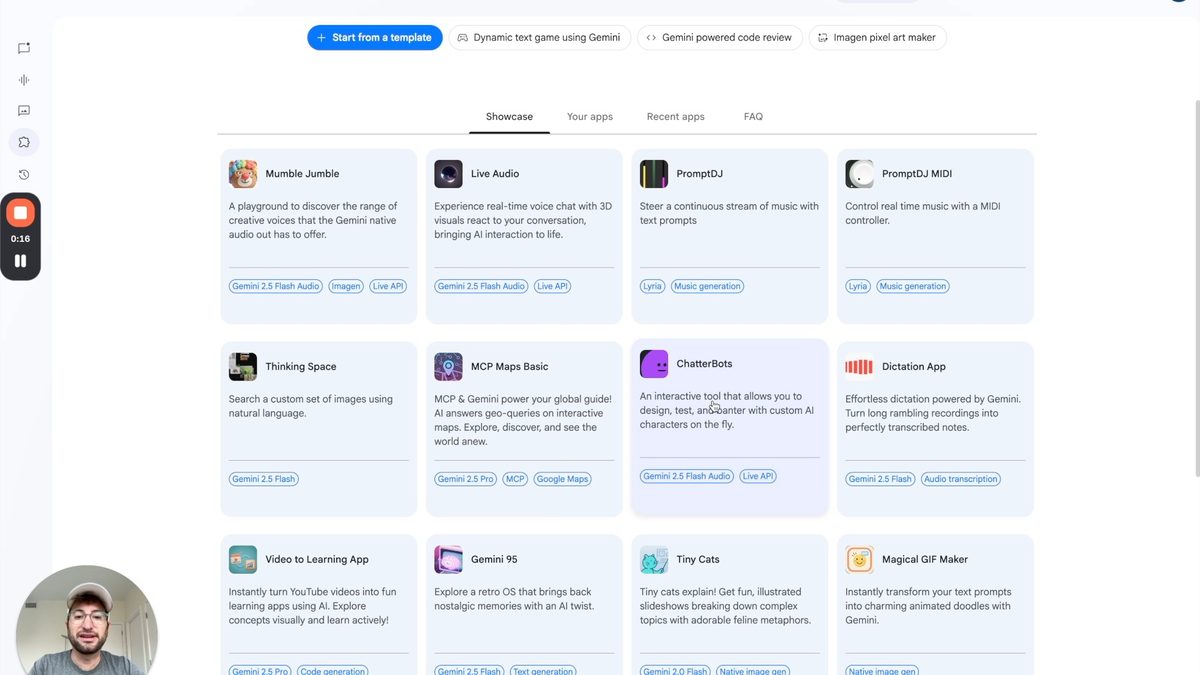
- Under "Showcase," click on "Chatterbots."
- You'll see an app preview where you can test the default chatterbot.
The Chatterbots showcase provides an excellent starting point for creating your language learning app. It demonstrates how AI can engage in conversation, which we'll modify to suit our language tutoring needs.
Building a Conversational Language Learning App
Now that we have our foundation, let's transform the default chatterbot into a language tutor:
Step 1: Modify the Existing Template
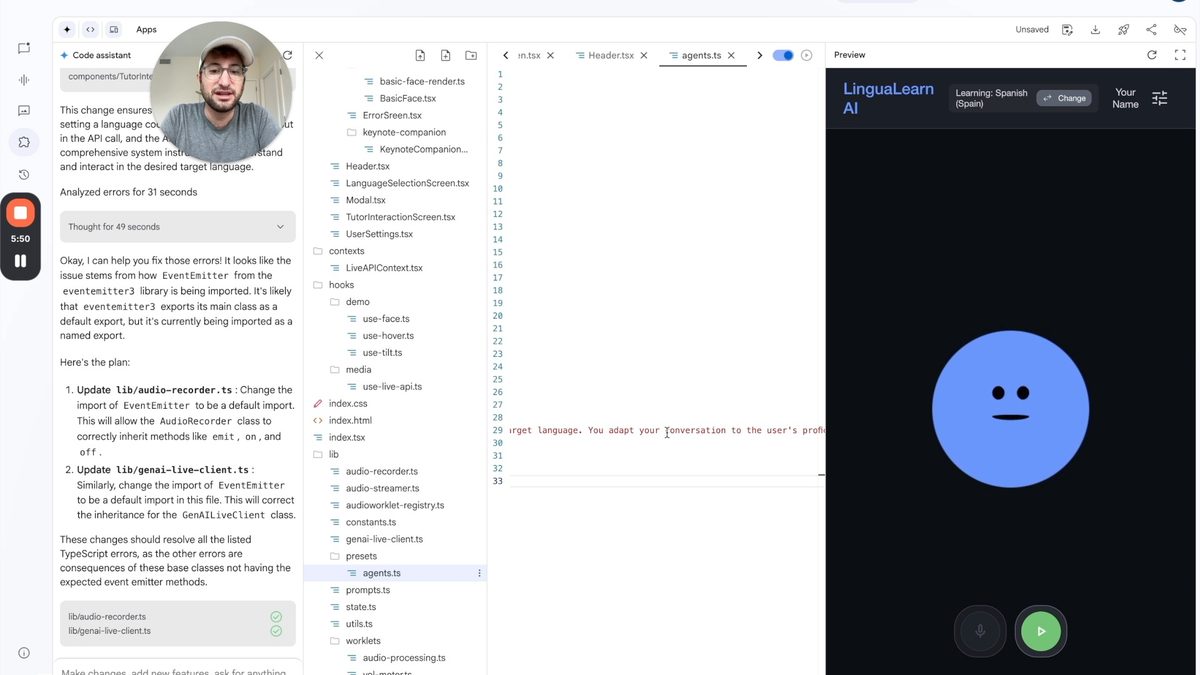
Start by updating the app's purpose. In the chat interface on the left side of the screen, instruct the AI to convert the app into a language learning tool. Specify that you want students to be able to choose their language and get started with lessons.
Step 2: Customize the AI Language Tutor Personality
To create a more effective language learning experience, we need to adjust the AI's personality. Navigate to the "agent.ts" file and modify the personality description. Here's an example:
You are a friendly, patient, and highly encouraging AI language tutor. Your primary mission is to help the user practice speaking and improve their fluency. You can adapt your conversation to the user's proficiency level. You want to make it an enjoyable experience, and you're enthusiastic and positive. You speak English to start and will add the language the user wants to learn conversationally. Assume the user is a complete beginner.
Step 3: Implement Language Selection
To allow users to choose their preferred language, you'll need to modify the app's initial prompt. Look for the "prompts" section in the code and update it to include language selection options.
Step 4: Adjust Prompts for Beginner-Friendly Interactions
Ensure that the AI starts conversations in English and gradually introduces the chosen language. Update the prompt to reflect this approach:
Start in English and assume the user is a complete beginner but use the language conversationally. Add in the language as you go.
More Things You Can Build with Google AI Studio
While we built a language learning app above, Google AI Studio is great for many types of AI projects. Here are more ideas I've tested:
1. Customer Support Chatbot
Use the Chatterbots template to create a support bot that answers common questions. I built a simple FAQ bot in about 20 minutes by:
- Starting with the Chatterbots showcase
- Adding my FAQ content to the system prompt
- Tweaking the personality to be helpful but concise
The built-in voice capabilities mean users can speak their questions—something you'd need additional APIs for on other platforms.
2. Content Summarizer
Paste in long documents and get AI-powered summaries. Gemini 3's large context window (up to 1 million tokens) makes this particularly effective for:
- Research paper summaries
- Meeting transcript highlights
- Long-form article digests
3. Code Explainer Tool
Built a simple app that takes code snippets and explains them in plain English. Helpful for:
- Learning new programming languages
- Understanding legacy codebases
- Teaching beginners
For more AI project ideas, check out our AI app ideas guide.
Debugging and Optimizing Your AI-Powered Language Practice App
As you build your app, you may encounter some challenges. Here are some tips to help you debug and optimize your creation:
Identifying and Resolving Common Errors
- Pay attention to error messages in the chat interface.
- Use the "Autofix" feature when available to resolve simple issues.
- If you encounter unsupported language codes, remove them from the model call and rely on prompts instead.
Fine-tuning Prompts for Desired Behavior
Sometimes, the AI may not behave exactly as you want. In these cases, you'll need to refine your prompts. For example, if the AI starts speaking only in the target language, adjust the prompt to ensure it begins in English and gradually introduces new vocabulary.
Tips for Effective AI App Debugging
- Make small, incremental changes and test frequently.
- Use clear and specific instructions when prompting the AI to make changes.
- Don't hesitate to manually edit code files if the AI doesn't make the desired changes.
Advantages of Using Google AI Studio for Prototyping AI Applications
Google AI Studio offers several benefits for those looking to create AI-powered language learning apps:
Built-in Integration with Google Gemini 3
One of the most significant advantages is the seamless integration with Google's advanced AI model, Gemini 3. This integration allows for powerful natural language processing capabilities without the need for complex setup.
No Need for Separate API Connections
Unlike other platforms, Google AI Studio doesn't require you to connect external APIs or manage API keys. Everything is built-in, making the prototyping process much smoother and faster.
Free Prototyping Capabilities
Google AI Studio allows you to prototype your AI applications for free. This is a great way to test your ideas and refine your app without incurring any costs.
Limitations and Considerations
While Google AI Studio is a powerful tool, it's important to be aware of its limitations:
Restricted to Google's AI Models
You're limited to using Google's AI models, which means you can't incorporate other AI services like OpenAI's GPT or Anthropic's Claude.
Potential Challenges in Deployment and Hosting
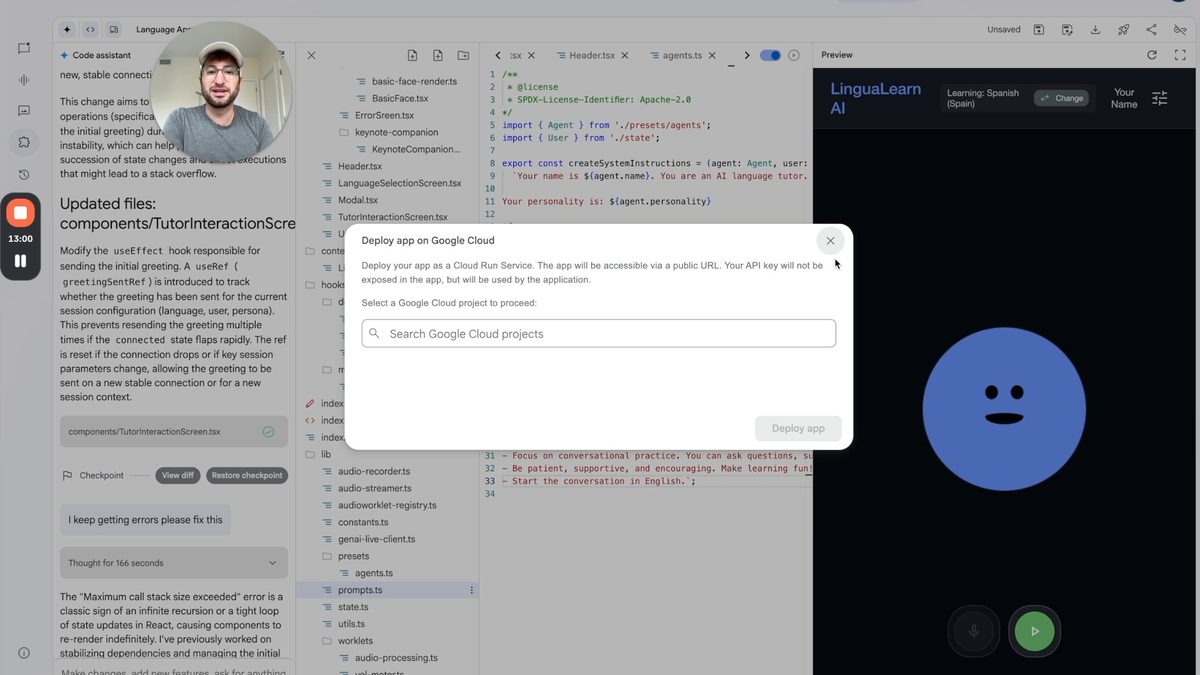
While you can deploy your app on Google Cloud, the process might be more complex compared to other no-code platforms. Additionally, if you want to host your app elsewhere, you'll need to figure out how to handle API connections and keys.
Comparison with Other AI App Development Tools
Google AI Studio is great for prototyping, but it may not offer as much control or flexibility as some other AI development tools. Here's how it compares:
| Feature | Google AI Studio | Lovable | Bolt | Cursor |
|---|---|---|---|---|
| Starting Price | Free 🏆 | $0-$100/mo | $0-$200/mo | $0-$40/mo |
| AI Model | Gemini 3 only | Claude + GPT-5 | Multiple models | Multiple models |
| Voice/Audio Apps | ✅ Built-in 🏆 | ❌ No | ❌ No | ❌ No |
| Database Integration | Limited | ✅ Supabase 🏆 | ✅ Yes | ✅ Yes |
| Deployment | Google Cloud | One-click 🏆 | One-click | Manual |
| API Setup Required | ❌ None 🏆 | ❌ None | ❌ None | ✅ Required |
| Best For | AI prototyping | Full web apps | Quick builds | Developers |
Consider your specific needs when choosing between Google AI Studio and alternatives like Bolt or Lovable.
📚 Explore More AI Coding Tools
Not sure if Google AI Studio is right for your project? Compare it with other popular AI builders:
- Lovable Review – Best for full-stack web apps with databases
- Bolt.new Review – Fast prototyping with multiple AI models
- Cursor Review – Best for developers who want AI assistance
- Replit Agent Review – Great for learning to code
- V0 Review – Best for UI/component generation
- Best AI App Builders 2026 – Full comparison of all top tools
The Future of AI-Powered Apps, Including AI Language Tutors
The potential for AI-powered language learning apps is immense. As tools like Google AI Studio become more accessible, we can expect to see increasingly sophisticated and effective language learning applications. These apps have the potential to make language learning more engaging, personalized, and efficient than ever before.
As AI technology continues to advance, we can anticipate even more features in language learning apps, such as:
- Real-time pronunciation feedback
- Personalized lesson plans based on learning style and progress
- Integration with augmented reality for immersive learning experiences
- Advanced natural language processing for more nuanced conversations
The future of language learning is bright, and tools like Google AI Studio are paving the way for innovative educational experiences.
All-in-all, Google AI Studio is a powerful tool that developers should try.
Ready to take your no-code skills to the next level? Sign up for No Code MBA and learn how to build apps, websites, automations, and more without writing a single line of code. Whether you're interested in AI, web development, or app creation, we have courses to help you achieve your goals.
Click here to join now!
Frequently Asked Questions
Is Google AI Studio completely free to use?
Yes, Google AI Studio is 100% free for prototyping and development. You only pay if you deploy to Google Cloud for production use. This makes it one of the best options for testing AI app ideas without any upfront cost.
Google AI Studio vs Vertex AI: What's the difference?
Google AI Studio is designed for quick prototyping and experimentation—it's more user-friendly and free to use. Vertex AI is Google's enterprise-grade ML platform with more features for production deployments, data pipelines, and model training. Start with AI Studio for prototypes, graduate to Vertex AI for production.
Can you deploy apps from Google AI Studio?
Yes, but the process is more technical than platforms like Lovable or Bolt. You can deploy to Google Cloud Run, but you'll need to handle some configuration. For simpler deployments, consider exporting your code and using a platform like Vercel or Netlify.
What AI model does Google AI Studio use?
Google AI Studio uses Gemini 3, Google's most advanced AI model. It supports text, code, images, and audio—making it versatile for many app types. However, you can't use other models like GPT-5 or Claude within AI Studio.
Do I need coding experience to use Google AI Studio?
Some coding knowledge helps, but it's not required. Google AI Studio provides templates and a chat interface for building apps. For complex customization, you'll need to edit TypeScript files. If you're a complete beginner, platforms like Lovable might be easier to start with.
Google AI Studio vs ChatGPT: Which is better for building apps?
They serve different purposes. ChatGPT is a conversational AI assistant. Google AI Studio is a development platform for building your own AI-powered applications. If you want to create and deploy an AI app, use AI Studio. If you just need AI assistance for tasks, use ChatGPT.
Can I use Google AI Studio for commercial projects?
Yes, you can build commercial apps with Google AI Studio. Review Google's terms of service for production use, and factor in Gemini API costs for your deployed app. The free tier is generous for prototyping, but production usage is pay-as-you-go.
What are the limitations of Google AI Studio?
The main limitations are: (1) Only Google's AI models are available—no GPT-5 or Claude 4, (2) Deployment is more complex than one-click platforms, (3) Limited database integration compared to tools like Lovable, and (4) Best for AI-focused apps rather than full web applications with complex backends.
Advertiser disclosure: some links on this website are affiliate links, meaning No Code MBA may make a commission if you click through and purchase.